

“p” is true if and only if p.
This is called the “disquotational principle,” since it removes the quotes from p. It’s a relatively uncontroversial, bare bones definition of truth. Correspondence theorists, pragmatists, and deflationists are all perfectly happy to say, “well yeah duh, [insert proposition here] is true if and only if it’s the case that [proposition]. Who could argue with that?”
The disagreement between (and within) the various groups arises over what else, if anything, truth is. They quibble over what it would mean for the second part of the principle, namely, the disquoted part, to obtain. Correspondence theorists think it obtains when and only when there is a relation of reference between the proposition and some facts or state of affairs out in the world. Pragmatists say it obtains when and only when it is useful, it “checks out” in our practices of verification and inquiry, and so on. Coherentists give an account about how the assertion coheres with our previous system of beliefs.1
Perhaps the most interesting group is the deflationists (also known as the disquotationalists or minimalists), who think the disquotational principle is all one can say about truth. For them, to say “‘the cat is on the mat’ is true” is just to assert “the cat is on the mat,” and vice versa. The predicate “is true” is redundant. Deflationists explain our use of the word “true” by pointing to its helpful linguistic functions, as for instance allowing one to utter propositions like “whatever Paul says is true” rather than individually asserting every damn thing Paul says, which would take forever. Truth itself, say the deflationists, is unsubstantial. It is just a logical tool for assertion. Quine and Rorty held this view. Though Quine was more reluctant than Rorty to adopt the label, both of them were considered pragmatists.
Not all pragmatists agree with them. Some pragmatists worry that disquotationalism leads to something like relativism (which I know isn’t an unpopular opinion on Philstack, but bear with me Remi). This tension within pragmatism can be understood as a split between left pragmatists and right pragmatists. The left leans towards relativism, and the right leans towards objectivity (while of course remaining fallibilist and never appealing to representationalism, which they’d argue doesn’t have a monopoly on objectivity). The right pragmatist Cheryl Misak wrote a great paper called “Pragmatism and the Function of Truth,”2 where she argues that the disquotationalist theory of truth espoused by Quine and Rorty cannot explain the “friction” that characterizes our disagreements. Her critique of disquotationalism is that it allows assertions to sort of slide past one another without any means of arbitrating their relative merits. Her goal is to give a more robust, objective account of truth than what the disquotationalists offer while remaining a “good pragmatist.”
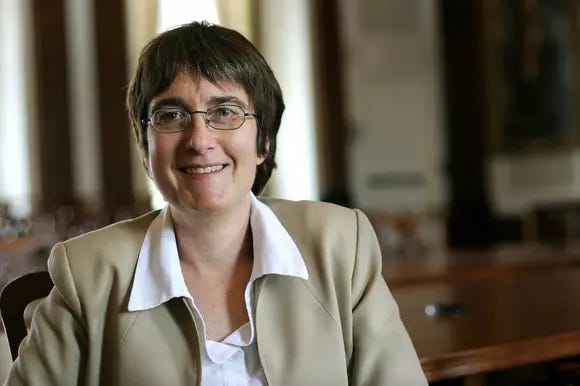
Misak contrasts disquotationalism (and the James-Quine-Rorty lineage of pragmatism) with the approach she believes is represented by herself, C.S. Peirce, and Frank Ramsey. She admits that the disquotational principle is trivially correct (if uninteresting), but she worries that it doesn’t fully capture what truth means for us in our practices and, thus, that disquotationalism is too deflationary. She agrees with the core idea of disquotationalism that to say something is true is nothing more than to assert it, but then she takes a further, crucial step, which is to ask what would it actually mean to assert something. It would mean that you believe it to be true, and to believe something is true means that you have aimed at truth through inquiry. Misak identifies what she calls the “norms of inquiry” that govern assertion: reason-giving, evidence, fact-checking, standards of good belief, trying to avoid mistakes, etc. These norms hold us accountable for our assertions.
Misak offers a naturalist account of objectivity akin to what Peirce offers with his convergence thesis: truth is whatever would be agreed upon at the ideal limit of all inquiry. Of course we could never know if we’re at the limit, but in theory it’s an objective state that exists. Peirce distanced himself from James’ plastic account of truth (“the true is just what’s useful”), coining the term “pragmaticism” to differentiate his own account. Ramsey, like Misak, found the disquotational principle by itself too thin to describe the workings of truth. He was working on a behaviorist causal account of truth before he died at the early age of 26. What Misak, Peirce, and Ramsey all seem to have in common is their view that when we look at our practices (which is what pragmatism is all about) we see that we already do aim at getting things right. Truth for them is therefore objective, albeit within the bounds of human practice.

While it would certainly be nice if Misak were right, I don’t know that assertion is always or even usually governed by norms of inquiry. Let’s be honest. People often say stuff just to say stuff. People lie, and gullible people repeat the lie without really believing in it or checking its veracity. Some say this happens a lot more in the 21st century than it did in the past. They’ve called ours a “post-truth” era, citing examples like the WMD scam used to justify the invasion of Iraq, online disinformation, and the rise of Trumpism. I used to think this was a valid hypothesis, as shown in an earlier post where I critique postmodernism, but recently I’ve been more inclined to say that cultural truth has always been a function of powerful interests, of violence, of who owns the means of cultural production.
The only reason things seem more chaotic now is that democratized digital media has outcompeted traditional establishment media. In what Lyotard called the “postmodern condition,” a few more or less centralized metanarratives have been subjected to a democratized multitude of competing metanarratives. Power, and thus the ability to arbitrate truth, is more diffused today, but power has always been the determining factor. Given all this, cynicism about truth is understandable. Rorty argued truth is just “warranted assertibility,” defined as “what our peers will let us get away with saying.”
Kids who grow up in a racist society will adopt racist beliefs repeated to them enough times, and when they grow up these beliefs will have become so ingrained that no evidence of the racialized group’s dignity will persuade them that they’re wrong. Nevertheless they’ll unhesitatingly call their beliefs “true.” I don’t think that I could have a rational discussion with such people and persuade them to discard their views no matter how much I appeal to norms of inquiry. But I also don’t doubt that they feel just as strongly that their beliefs are true as I think they’re false. Productive disagreement requires a background of agreement, a “form of life.” In the absence of shared norms, sooner or later our dialogue would devolve into the hurling of abuses. An honest account of truth needs to recognize the often unglamorous psychology behind our invocation of it: the brutality and savagery of assertion, its embeddedness within our bodies, its proximity to our fears, egos, lusts, and the worst parts of our nature.
Misak wants to bring back the good ol’ Enlightenment faith in truth. She’s optimistic that the search for truth leads to something good in the end. I respect that. What I’ve realized, though, is that her norms of inquiry can only be aspirational, not taken for granted. I agree that as progressives we should use norms of inquiry and strive to universalize them in our education systems, but we shouldn’t kid ourselves that they are self-evident. Our opponents need to be convinced that our vision is good for them too, and simply appealing to our perspective is inadequate. As far as we know, they have their own norms of inquiry that they believe in as strongly as we do ours. As Nietzsche put it, we can’t look past our own corner, and it is a “blindness” to act as if our perspective were the whole.
Perhaps, then, we should take seriously Rorty’s suggestion that we stop worrying so much about absolute truth and start emphasizing hope instead: the shared dream of humanity to improve life for our grandchildren. That way we could at least be honest about the natural, animalistic origins of everything we believe and do. As the evolutionary disposition that brings out the most noble, worthwhile affects of our communal animal nature, hope might have a greater claim to universality than even truth has.
To be sure, these people don’t necessarily think their views are strictly-speaking incompatible. They only place more emphasis on one account of truth over the others.
The article is paywalled. Let me know if you’re interested in reading it. I can send you the doc.
The problem with pure disquotationalism is that truth seems to be a property of sentences. Even the left-pragmatist explanations like usefulness and assertibility are properties of sentences (and ones which arent necessarily disquotational).
There are also speech-acts that [you can get away with/ are useful] that noone would call true, so the next challenge is to explain what "assertions" are, and how they differ from, say, imperatives, without invoking truth-directedness.
>Kids who grow up in a racist society will adopt racist beliefs repeated to them enough times, and when they grow up these beliefs will have become so ingrained that no evidence of the racialized group’s dignity will persuade them that they’re wrong.
Yup, its a good thing americans started sending their kids to grow up in heaven, otherwise society would have remained racist forever.
Great piece