

When chiiii reached out to me and asked if I could write a piece on the Maoist theory of contradiction as part of an essay compilation, I gladly accepted, given that Marxism is one of the interests I list in my bio; but I’d be lying if I said I wasn’t unsure how to proceed. In recent months I’ve become, in true Kantian fashion, critical of metaphysical dogmas (even when they profess to be anti-metaphysical). At the same time, I recognize that our metaphysical talk has really important effects on our political praxis and that we certainly can’t ignore it.
As a compromise between these two contradictory tendencies within myself (ba dum tss), I’ll discuss the 1964 debate over Mao’s theory of contradiction with a focus on how it relates to the real political forces that have had stakes in certain views. I argue that Mao’s theory of contradiction was deliberately formulated and utilized in direct contrast to Stalinist orthodoxy. Through the course of this article, I’ll show how Mao’s theory of contradiction 1) urges permanent, continuous struggle and the rejection of revisionism and class reconciliation, and 2) was tailored to the concrete conditions of the Chinese historical situation, where the “revolutionary subject” was not the traditional proletariat but the peasantry.
The Rejection of Class Reconciliation
Okay, let’s set the scene: it’s 1964 in Liu Shaoqi’s China, almost fifteen years into the establishment of the People’s Republic. The disastrous, famine-inducing Great Leap Forward of the late 50s has already passed. Members of the Party have criticized Mao for the failure, prompting him to step down from chairman to a passive role so that moderates like Liu Shaoqi could take the reins. Liu would be chairman from 1959 to 1968, when the students would denounce him as a “capitalist roader” and purge him in Mao’s Cultural Revolution.
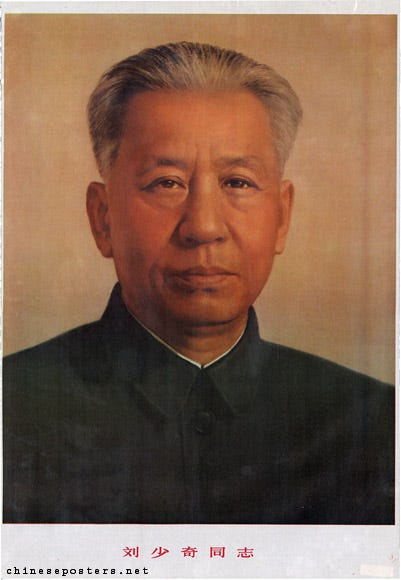
In an April lecture at the Higher Party School, the philosophy professor Yang Xianzhen declares that Lenin’s notion of the “unity of opposites”1 means, in the end, that “two unites into one” (implying reconciliation between classes, countries, and economic systems). This contradicts the Maoist line that “one divides into two”2 (implying infinite struggle, negation, division). In May, Yang’s students Ai Hengwu and Lin Qingshan publicize Yang’s ideas in the newspaper Guangming Ribao, igniting a fierce debate in the press and in schools across the country over the nature of dialectics. The debate is between, we might say, the Yangists and the Maoists.
Keep in mind that although Mao wields considerably less power in 1964 than he did in years past, the philosophical orthodoxy is still overwhelmingly Maoist. Mao’s legend—his reputation as a brilliant military strategist and as the savior of the Long March—would never quite wear off. The two 1937 lectures Mao gave in the midst of the united front against Japan, namely, “On Practice” and “On Contradiction,” are still considered at this time to be novel contributions to Marxist philosophy and rigorously studied by party cadres.
So to understand the debate between the Yangists and the Maoists, we need to understand “On Contradiction.” It’s a dense and long read, but of special importance to us is Section Five, which is titled “On the Identity and Struggle of the Aspects of a Contradiction.” For Mao, contradiction is universal and inherent in all processes, including motion itself. However, there are moments when the opposite terms of a contradiction achieve an “identity,” that is, they transform into one another and begin a new process on new terms. These transformations happen under certain sufficient and necessary conditions, meaning that identity is conditional and relative. As Mao explains,
Why can an egg but not a stone be transformed into a chicken? Why is there identity between war and peace and none between war and a stone? Why can human beings give birth only to human beings and not to anything else? The sole reason is that the identity of opposites exists only in necessary given conditions. Without these necessary given conditions there can be no identity whatsoever.
Why is it that in Russia in 1917 the bourgeois-democratic February Revolution was directly linked with the proletarian socialist October Revolution, while in France the bourgeois revolution was not directly linked with a socialist revolution and the Paris Commune of 1871 ended in failure? … The sole reason is the concrete conditions of the time. When certain necessary conditions are present, certain contradictions arise in the process of development of things and, moreover, the opposites contained in them are interdependent and become transformed into one another; otherwise none of this would be possible.
Mao contrasts the relativity of identity with the absoluteness of struggle. Identity only happens under given conditions, whereas struggle is constant.3
It is because the identity of opposites obtains only in given conditions that we have said identity is conditional and relative. We may add that the struggle between opposites permeates a process from beginning to end and makes one process transform itself into another, that it is ubiquitous, and that struggle is therefore unconditional and absolute.
For Mao, struggle is ontologically prior to identity. Some Marxist theorists think the dialectical process works through what Hegel called the “negation of the negation,” an act of labor leading to a higher stage in which the opposing terms are both preserved and transcended. This way of thinking results in a political teleology that has as its end a notion of permanent identity, whether it be the abolition of class society as such, the coalescing of opposing parties into a unified whole, the “end of history,” or some other such formulation. But Mao rejects the negation of the negation. For him, revolutionary situations in which opposing classes transform into one another are merely transitory nodes that facilitate an endless parade of contradictory processes. There is no final reconciliation, no end point toward which struggle tends, because the universal just is infinite negation, and any particular, momentary identity can only be conditional upon this infinite negation.4 Even the Chinese word for contradiction, 矛盾 (máo dùn), translates literally to “spear-shield” and refers to an old tale that raises the paradox of what would happen if an unstoppable spear and an impenetrable shield were to clash. Its etymology implies total logical exclusivity, the impossibility of overlap.
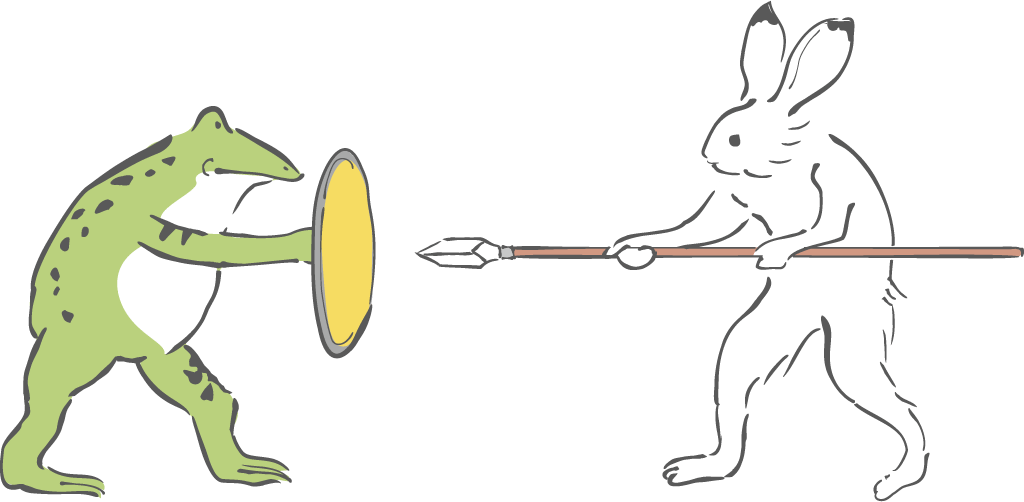
The debate between the Yangists who say “two unites into one” and the Maoists who say “one divides into two” is therefore based on their fundamental difference in attitude toward the negation of the negation. Although such an abstract philosophical debate might not seem like it has much practical significance, Mao and his followers insist that it does.5 The Maoist sees Yangism as not only a gross philosophical error, but as one that actively serves the interests of reactionary classes. As the Sept. 11 issue of Peking Review polemicizes,
… to view relations between the various classes of society in accordance with the concept that “two combine into one” as advocated by Comrade [Yang Xuenzhen] will inevitably lead to obscuring the boundaries between classes, and to repudiating the class struggle, and thus lead to the theory of class conciliation.6
Nor was Yang the only target. He was just the convenient poster-boy of a revisionism Maoists believed rampant both in China and in socialist movements around the world due much to the influence of Moscow. Khrushchev made the Secret Speech in ‘56, and by the early ‘60s the Chinese were calling the U.S.S.R. a “social imperialist nation.” Notably, a decent number of French intellectuals and militants sided with Mao, championing his spirit of continuous struggle as a contrast against what they perceived to be the revisionist state bureaucracies of the Parti communiste français and the Soviet Union. In his Théorie de la contradiction (1975), Alain Badiou argued that Mao’s dialectic was the truest and most developed formulation of Lenin’s unity of opposites. He saw the 1964 debate as foreshadowing the Great Proletarian Cultural Revolution, which began only two years later and would inspire French students to revolt in May ‘68. Reciprocally, of course, the 1967 Shanghai Commune’s failed experiment in direct socialist democracy was, both in its inspiration and in its fate, thoroughly Parisian.
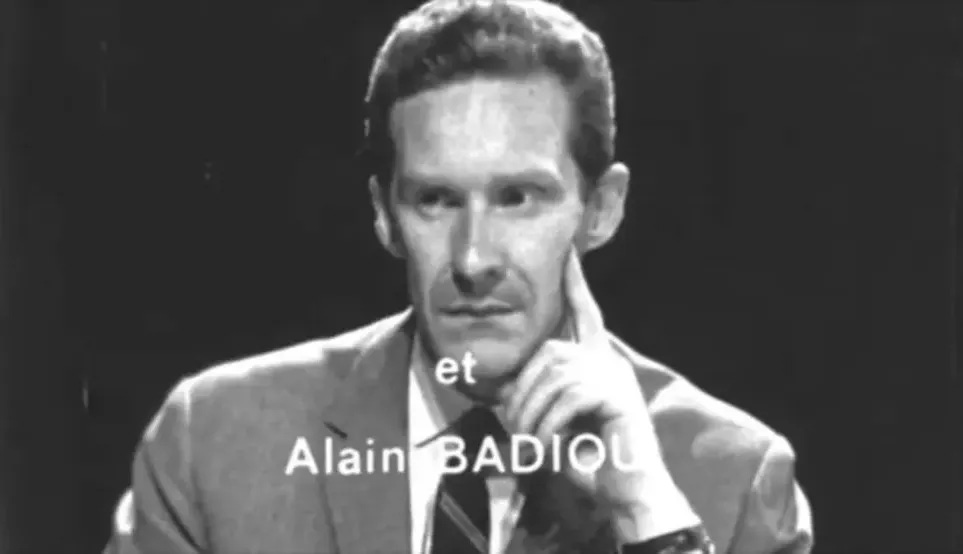
Badiou’s Mao could resist revisionism and the reinstatement of capitalism because he took negation to its extreme: instead of doing what Stalin did, which was to unify society via the development of productive forces, Mao kept struggling and dividing society, including, during the Cultural Revolution, even the Party itself into a bourgeois line and a proletarian line (“bombard the headquarters!”). One divides into two, two into four, and so on ad infinitum.
… the path chosen by Stalin could not serve as an example, since it had been unable to prevent Khrushchev's bourgeois coup d'état… Not the positive unity of the infrastructure, but the scission of the superstructure and of the party itself into a proletarian line and a bourgeois line. From the Jinggang Mountains to the Cultural Revolution, Mao Zedong's thought formulates itself as a counter-current, as a labor of division. Hence its increasingly precise deployment of the consequences of the principle of the unity of opposites. A rebel thought par excellence, a thought that is the revolt of revolt itself: dialectical thought.7
The Particularity of Contradiction
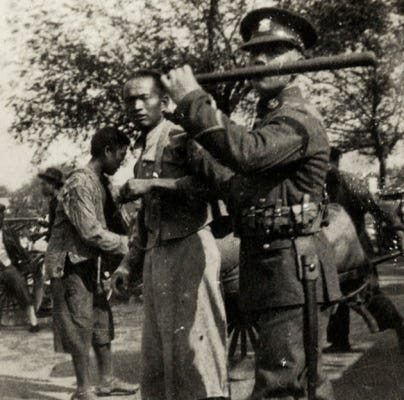
The tension leading up to the Sino-Soviet Split had been simmering since the start of the Chinese revolution. On May 30th, 1925, Shanghai workers began a major strike after British police shot and killed 16 anti-imperialist demonstrators. As the primary organizer of the May 30th Movement, the Chinese Communist Party became very popular. Notwithstanding, the Comintern urged a united front between the Communists and the Soviet-trained Kuomintang, many of whose members came from the anti-communist land-owning classes. Stalin directed the Chinese Communists to avoid arming workers and peasants; because of this, they were left vulnerable to Chiang Kai Shek’s White Terror, a brutal purge of leftists across the country that began with the 1927 Shanghai Massacre. This made the Chinese Communists very suspicious of the Soviets going forward, though the two pretended to be chummy for the public eye.
There was also a theoretical disagreement over the rightful revolutionary subject: proletariat or peasantry? When Mao visited his childhood province Hunan in 1925, he studied the uprising (the peasant associations, the anti-landlord actions taking place, etc) and quickly became convinced it was the peasantry; his famous 1927 “Report on an Investigation of the Peasant Movement in Hunan” became the founding text of Maoism. “The countryside surrounds the city,” declared Mao.
Wang Ming, the leading member of the “28 Bolsheviks” educated in Moscow, opposed Mao’s thesis because he believed only the urban proletariat could lead the revolution. Mao, for his part, thought it was Wang’s unshakeable faith in the city that led to Wang’s defeat in Chiang’s fifth “Encirclement and Annihilation” campaign against the Jiangxi Soviet. Wang neglected the peasants and kept waiting for the objective conditions that would spark the urban masses to revolt; he didn’t realize that the White Terror had scared China’s tiny proletariat into submission. Additionally, Wang blamed the Communists’ vulnerability to the White Terror on a single person, Secretary Chen Duxiu, rather than on the Soviet orders Chen was following. In “Stalin and the Chinese Revolution” (1930), Trotsky makes more or less the same charge: the Comintern scapegoated Chen Duxiu for a failure that was its own fault.
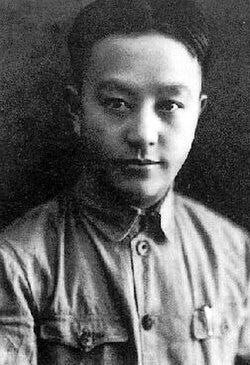
Mao claims to be addressing dogmatists in “On Contradiction.” Well, who are these dogmatists? In light of what we said, I think it’s likely that he intended to take aim at the 28 Bolsheviks who uncritically toed the Stalinist line on matters both military and ideological. I daresay Wang Ming stood at the forefront of Mao’s mind.8 Hence, even in its origins as a theory made in conditions of civil war and Japanese aggression, Maoist dialectics stood in tension with Soviet thought. For example, Mao discusses what he calls the particularity of contradiction, which introduces the following considerations: the unique conditions that differentiate one contradiction from another, the distinction between a “principal” and a “secondary” contradiction, and the “principal aspect” of a contradiction. These considerations are crucial for a society in which the principal contradiction is decidedly not the orthodox Marxist struggle between the proletariat and the bourgeoisie but rather between all of the classes (except the compradors) and imperialism, for a society in which the peasantry constitutes 80% of the population and “economic backwardness” is the norm.
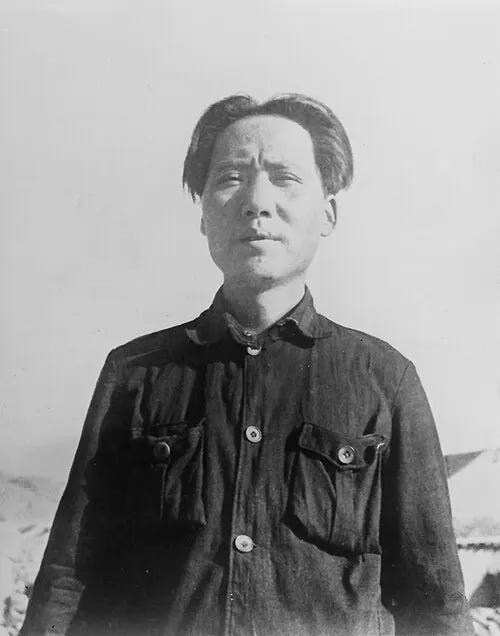
At one point in the lecture, Mao says that the aspects of a contradiction, i.e., the opposite terms, undergo “reciprocal transformation” and the principal aspect becomes the secondary. He says that there are moments in history when the orthodox Marxist privileging of the base over superstructure, practice over theory, and productive forces over relations of production is reversed; the point here isn’t just the concession that both are important (a point that orthodox Marxists would agree with) but that there are moments when the base-superstructure hierarchy flips entirely and the revolution cannot continue without first a change in culture. While one could read Mao’s point as foreshadowing the Cultural Revolution’s war against Confucianism and revisionism, it also reflects lessons Mao had already learned from the anti-Confucian New Culture Movement of the 1910s-20s.
Mao’s biggest contribution to Marxist philosophy (to say nothing of his military insights) was the introduction of fluidity into the static, state-bureaucratic Soviet formulation of dialectical materialism; this allowed Maoism to catch on in many Third World and New Left movements, as for instance the Shining Path in Peru, the Naxalites in India, the K-Groups in West Germany, and the Black Panthers in America. Today Maoists typically see modern China as revisionist, at best a social democracy, at worst a capitalist dystopia no better than the U.S. Although I won’t take a side in that bag of worms, their critique again goes to show the relentless negation and struggle encoded in Maoism as a revolutionary ideology.
From Lenin: “Dialectics is the teaching which shows how opposites can be and how they happen to be (how they become) identical—under what conditions they are identical, transforming themselves into one another,—why the human mind should take these opposites not as dead, rigid, but as living, conditional, mobile, transforming themselves into one another.”
“Conspectus of Hegel’s The Science of Logic”, Collected Works, Russ. ed., Moscow, 1958, Vol. XXXVIII, pp. 97-98.
Mao derives this phrase from a formulation in Lenin’s Philosophical Notebooks, a series of summaries and fragments Lenin wrote on philosophical texts he was studying from 1914-16: “The splitting of a single whole and the cognition of its contradictory parts ... is the essence ... of dialectics.”
Collected Works, Vol. 38, F.L.P.H., Moscow, 1961, p. 359.
This is Mao’s interpretation of another passage in the Philosophical Notebooks. In a fragment found between a summary of Lasalle’s book on Heraclitus and a summary of Aristotle’s Metaphysics, Lenin writes: “The unity (coincidence, identity, equal action) of opposites is conditional, temporary, transitory, relative. The struggle of mutually exclusive opposites is absolute, just as development and motion are absolute.”
Another way to formulate this would be to understand every process to be equally affirmation and negation, so that there is never a stage of “synthesis” but only never-ending subsumption of the old by the new. Mao would say this in the Talk on Questions of Philosophy: “There is no such thing as the negation of the negation. Affirmation, negation, affirmation, negation . . . in the development of things, every link in the chain of events is both affirmation and negation. Slave-holding society negated primitive society, but with reference to feudal society it constituted, in turn, the affirmation. Feudal society constituted the negation in relation to slave-holding society but it was in turn the affirmation with reference to capitalist society. Capitalist society was the negation in relation to feudal society, but it is, in turn, the affirmation in relation to socialist society.”
In one bit I found interesting in his 1964 Talk on Questions of Philosophy, Mao admits that he used to be a Kantian transcendental idealist in his youth; that was when “I was a feudalist and an advocate of bourgeois democracy. Society impelled me to participate in the revolution.” As if his Kantianism was connected to his politics.
“New Polemic on the Philosophical Front: Report on the Discussion Concerning Comrade Yang Hsien-chen’s Concept That ‘Two Combine Into One’ by ‘HONGQI’S’ CORRESPONDENT,” reprinted from Peking Review, Sept. 11, 1964, https://www.marxists.org/subject/china/peking-review/1964/PR1964-37z.htm.
Théorie de la contradiction, 1975, Alain Badiou, http://www.entretemps.asso.fr/Badiou/Theorie-de-la-contradiction.pdf, pg. 23.
Wang would continue his anti-Maoist line throughout a long career. It’s quite remarkable that he survived not only this era but also the purges of the Cultural Revolution decades later.
"As the Sept. 11 issue of Peking Review polemicizes,
… to view relations between the various classes of society in accordance with the concept that 'two combine into one' as advocated by Comrade [Yang Xuenzhen] will inevitably lead to obscuring the boundaries between classes, and to repudiating the class struggle, and thus lead to the theory of class conciliation."
It seems to me that it could also lead to thinking that the oppressed class that now is ruling (after revolution) automatically receives the faults of the ruling class. That would mean that there is an ontological danger to power.
Anyway, this "spear and shield" "theory" -- I think most metaphysics actually qualify as hypotheses, if not less -- I mean, after all, we ARE working with words -- slippery beings in themselves -- I find rather neat in itself, but it feels oddly separate from Mao's actions. Do I think it led to the unethical purges of innocent people? No, but I do think that the metaphysics of the Maoists were doomed before they even came into attempts at praxis. Mao as far as I can tell did not really care about the nature of reality and was willing to divide his own people against each other in a reign of guilt -- classic totalitarian and selfish behavior.
Your suspicion of metaphysics/praxis is one I'm sympathetic with. I grew up in environments that, like the majority of Western and some Eastern history, claimed to be "one" with their metaphysics; but, it seems, epistemological policies seem to reveal more about a given regime's tolerance and justice towards any and all people.
Great to read your essay.